
Artificial Intelligence (AI) is no longer a futuristic concept — it’s embedded in our everyday lives. From virtual assistants and recommendation systems to healthcare diagnostics and autonomous vehicles, AI systems are transforming industries and influencing human lives. As its influence grows, so does the responsibility to develop and use AI systems ethically. This is where Responsible AI becomes not just important but essential.
What is Responsible AI?
Responsible AI refers to the development and deployment of artificial intelligence in a way that is ethical, transparent, accountable, inclusive, and beneficial to society. It ensures that AI technologies respect human rights, prevent harm, and empower all communities equally.
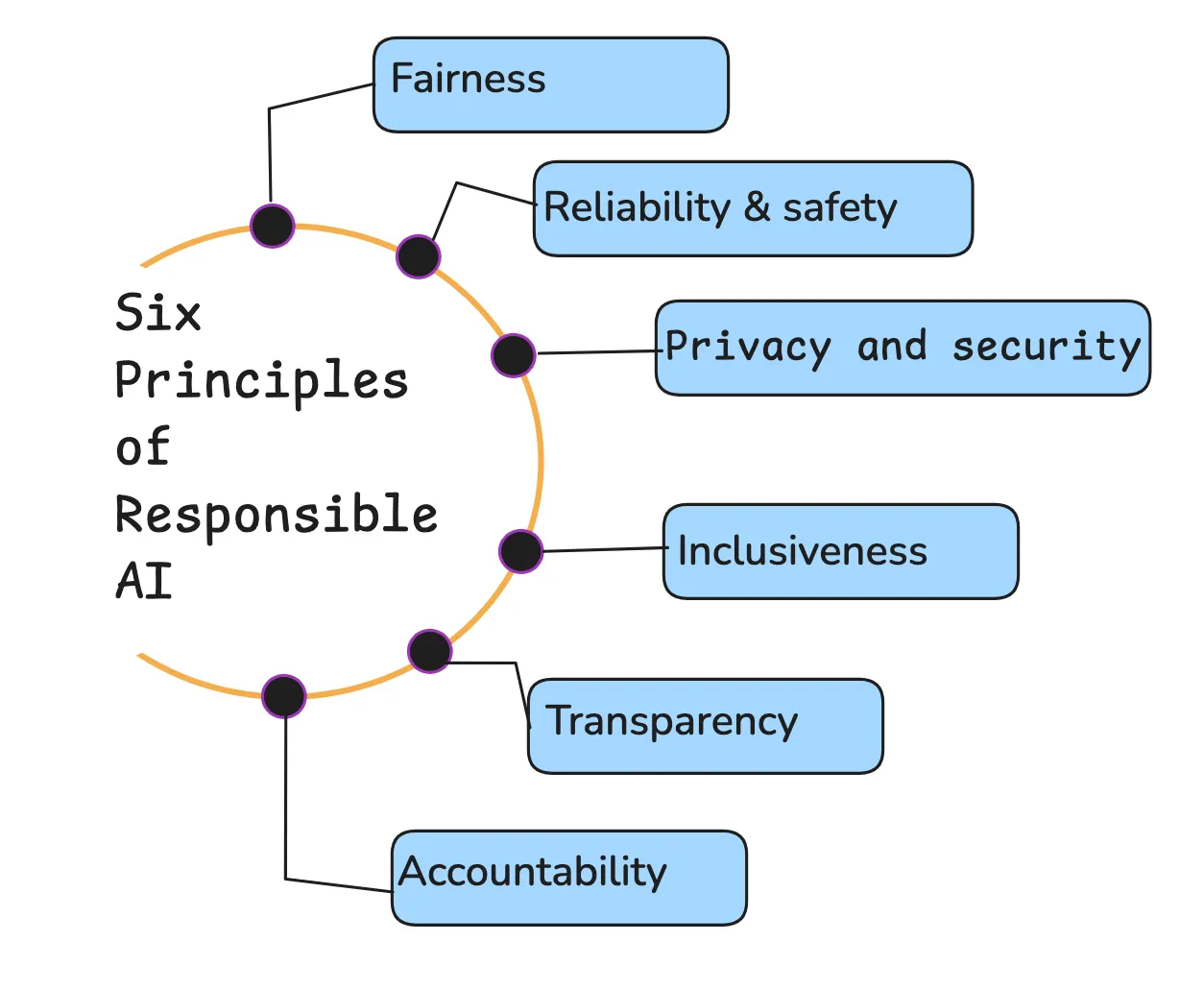
The Six Core Principles of Responsible AI
This article explores the six core principles of Responsible AI, maps them to real-world use cases, and outlines their critical role in ensuring sustainable and ethical AI integration across businesses.
- Fairness: AI systems should treat all people fairly.
- Reliability and safety: AI systems should perform reliably and safely.
- Privacy and security: AI systems should be secure and respect privacy.
- Inclusiveness: AI systems should empower everyone and engage people.
- Transparency: AI systems should be understandable.
- Accountability: People should be accountable for AI systems.
Fairness: AI systems should treat all people fairly
Fairness in AI means preventing discriminatory outcomes. This is crucial in domains like:
- Hiring platforms : Fair AI ensures candidates are assessed on merit, not gender, race, or geography.
- Lending and credit scoring: Fintech companies use fairness-aware models to ensure applicants from marginalised communities aren’t unfairly denied loans.
How to Ensure Fairness:
- Reviewing and audit training dataset.
- Use techniques like adversarial debiasing.
- Test models against diverse demographic samples.
- Provide human-in-the-loop review for sensitive decisions.
- Monitoring model performance across user segments.
- Implementing controls to override unfair model scores.
Real-world impact: In 2018, Amazon scrapped an AI recruitment tool after discovering it favoured male candidates for technical roles — highlighting the urgent need for fairness controls.
Reliability and safety: AI systems should perform reliably and safely
To build trust, AI systems must operate reliably, safely, and consistently.
AI must behave predictably — even in edge cases or under adversarial conditions. In high-stakes environments, reliability and safety are non-negotiable.
- Autonomous vehicles: Malfunctions could mean life or death.
- Medical diagnosis tools: Inaccurate predictions could lead to incorrect treatments.
Strategies to Achieve This:
- Rigorous testing in simulated and real-world environments.
- Redundancy systems for fail-safes.
- Continuous learning with built-in anomaly detection.
Case example: In 2021, a fatal crash involving Tesla’s Autopilot raised alarms about AI system reliability, sparking calls for stricter safety audits and clearer usage guidelines.
Privacy and security: AI systems should be secure and respect privacy
AI systems often rely on massive datasets — much of which can be sensitive. Privacy and security ensure that AI doesn’t become a tool for surveillance or misuse.
- Healthcare: Systems like Google Health handle personal medical records.
- Voice assistants (Alexa, Siri): Record user interactions daily.
Best Practices:
- Use data minimization: only collect what’s needed.
- Apply pseudonymization, aggregation, and strong encryption (e.g., envelope encryption).
- Store secrets using HSMs and cloud-native secure vaults (AWS KMS, Azure Key Vault).
Real-world lessons: The Clearview AI facial recognition case (where billions of face images were scraped without consent) became a flashpoint for global AI privacy legislation.
Inclusiveness: AI systems should empower everyone and engage people
AI must work for all — regardless of race, gender, ability, geography, or income. True inclusivity goes beyond avoiding harm; it ensures access and empowerment.
Business Applications:
- Google Translate: Expands to include low-resource languages.
- Microsoft Seeing AI: Helps visually impaired users “see” through narration.
Inclusiveness in Practice:
- Design with diverse personas.
- Localize for global and rural use (e.g., apps that work offline).
- Use accessible interfaces (voice, screen readers, captions).
Real-world example: Apple’s VoiceOver, a screen reader built into iOS, exemplifies inclusive design, empowering millions with visual impairments globally.
Transparency: AI systems should be understandable
If users and regulators can’t understand how AI reaches conclusions, trust is eroded. Transparency is key for accountability, auditing, and improvement.
- Credit scoring tools (e.g., Experian, CIBIL, Equifax): Users deserve to know why they were denied a loan.
- AI in criminal justice : Without transparency, bias can persist unchecked.
Tools & Techniques:
- Model explainability tools (e.g., LIME, SHAP, LOFO).
- Transparent documentation (Datasheets for Datasets, Model Cards).
- Audit trails and logging.
Case in point: The COMPAS recidivism algorithm was found to be biased against Black defendants — critics pointed out that its opaque logic couldn’t be independently scrutinized.
Accountability: People should be accountable for AI systems
The Accountability principle states that AI creators should be responsible for how their systems operate. They need to continuously monitor system performance and mitigate risks. Accountability in the AI industry is becoming a pressing issue as high-profile cases of algorithmic harm, bias, and abuse come to light. Critics increasingly argue that without accountability, AI creators hold too much power over opaque systems impacting lives.
AI systems must be accountable to people, and companies deploying AI systems must take responsibility for their operation.
Scenarios Requiring Accountability:
- AI-based loan approval or insurance pricing.
- Content moderation systems on social media platforms.
Key Actions:
- Define roles and responsibilities clearly.
- Set up internal AI governance boards.
- Allow for user redress in case of AI mistakes.
Real-world example: The EU’s AI Act mandates strict accountability and categorizes AI systems into risk levels, enforcing transparency, human oversight, and penalties for misuse.
Responsible AI is not a destination but a continuous journey. As technologies evolve, so must our governance, design standards, and accountability frameworks. Companies investing in Responsible AI not only build trust with users but also future-proof their operations against regulatory, reputational, and operational risks.
