
The world of AI computing is witnessing a seismic shift. AMD and Intel have set their sights on AI inferencing — a fast-growing segment that could disrupt Nvidia’s longstanding dominance. With businesses increasingly prioritizing cost-effective and energy-efficient solutions, the AI hardware landscape is ripe for transformation.
The Competitive Landscape
Nvidia has long held a commanding lead in AI training, with its GPUs being the gold standard. However, these GPUs are up to five times costlier than AMD and Intel alternatives. As enterprises seek to scale inferencing tasks, Nvidia faces mounting pressure to lower its prices.
CEO of AMD, highlighted the company’s confidence in its MI300 chips, projecting $5 billion in data center GPU revenue for 2024. Meanwhile, Intel is leveraging its CPU expertise to carve out a niche in the inferencing market.
The Shift Towards AI Inferencing
AI inferencing is poised to become a larger market than training, driven by the need for real-time applications. Gartner projects that by 2028, over 80% of data center workload accelerators will be dedicated to inferencing.
Inferencing GPUs are designed to consume less power compared to training GPUs, making them cost-effective for deployment at scale.
This shift is reshaping industries:
- Healthcare: AI-powered diagnostics and patient care.
- Retail: Personalized shopping and dynamic pricing.
- Finance: Fraud detection and risk management.
- Automative: Real-time inferencing in autonomous vehicles for navigation and safety features.
- Telecommunications: Network optimization and predictive maintenance for infrastructure.
- Manufacturing: Quality control using AI vision and predictive maintenance of machinery.
What This Means for Businesses
With AMD and Intel offering cost-effective alternatives, businesses of all sizes can harness the power of AI. Startups and SMEs stand to benefit the most, as they gain access to affordable, high-performance hardware.
What is AI Inferencing
AI inferencing refers to the process of using trained AI models to make predictions or decisions in real-time or near real-time based on new input data. It is a critical phase in the lifecycle of AI, following the training phase, where models are developed and trained on large datasets to recognize patterns or relationships.
How AI Inferencing Works
Model Training
- A model is trained on massive datasets using AI training hardware (e.g., GPUs from Nvidia).
- This phase involves intensive computational resources to optimize the model’s weights and biases.
Model Deployment
- Once trained, the model is deployed on hardware designed for inferencing tasks, where it processes real-world input data.
Inferencing
- The trained model is used to predict outcomes or classify data in live applications. Examples include identifying objects in an image, translating text, or making stock market predictions.
AI Inferencing Hardware
Inferencing typically requires different hardware compared to training:
- It focuses on low latency and high throughput for real-time applications.
- Energy efficiency and cost-effectiveness are critical.
- Hardware for inferencing includes specialized GPUs, CPUs, and accelerators like AMD’s MI300 or Intel’s AI-enabled CPUs.
- NVIDIA offers GPUs like the T4 Tensor Core GPU and A10 that are optimized for inferencing.
AI Inferencing Design
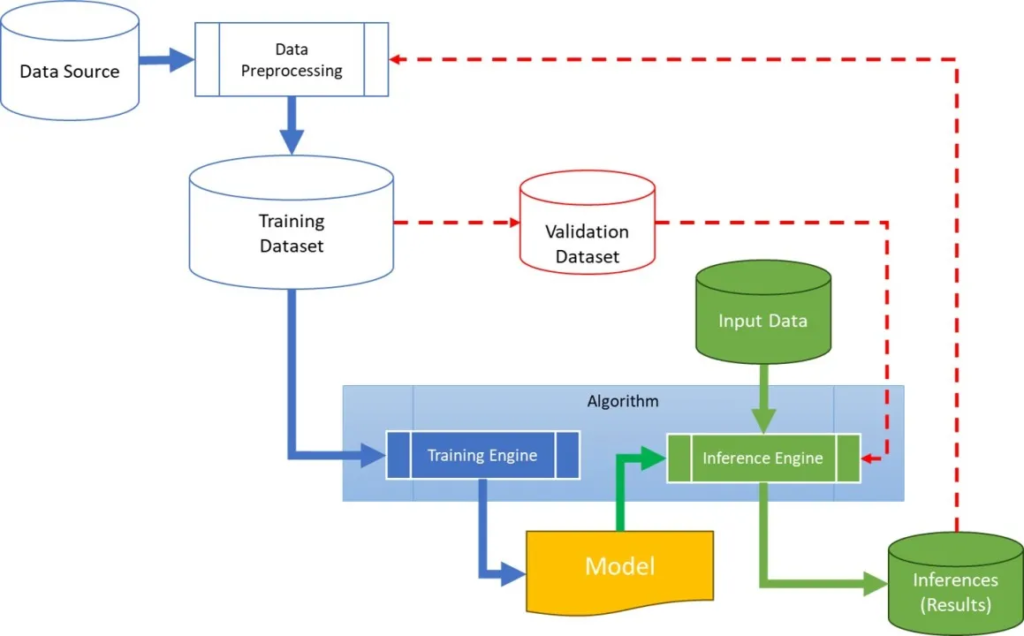
Explanation of the Diagram
Data Source
- Raw data is collected from various sources. This could be text, images, videos, or sensor data.
Data Preprocessing
- The raw data undergoes preprocessing to clean, normalize, and transform it into a format suitable for training.
- Preprocessing includes techniques like scaling, encoding, removing noise, etc.
Training Dataset and Validation Dataset
The preprocessed data is split into two parts:
- Training Dataset: Used to train the model by feeding it to the Training Engine.
- Validation Dataset: Used to evaluate the model’s performance and precision during training to avoid overfitting or underfitting.
Training Engine
- This component runs the algorithm to create a Model by learning patterns from the training dataset.
- The output is a trained model that is ready for use in inferencing.
Model
- The trained model represents the algorithm’s understanding of the data and can make predictions or decisions.
Inference Engine
- The Inference Engine takes Input Data and uses the trained model to generate predictions or inferences.
- Example: Predicting house prices, identifying objects in images, or translating text.
Inferences (Results)
- These are the final outputs or decisions generated by the AI system based on the input data.
Conclusion
As AMD and Intel challenge Nvidia, the AI inferencing market is set for an exciting phase of innovation and competition. Enterprises must stay agile, adapting to new technologies that promise to unlock unprecedented value.

