
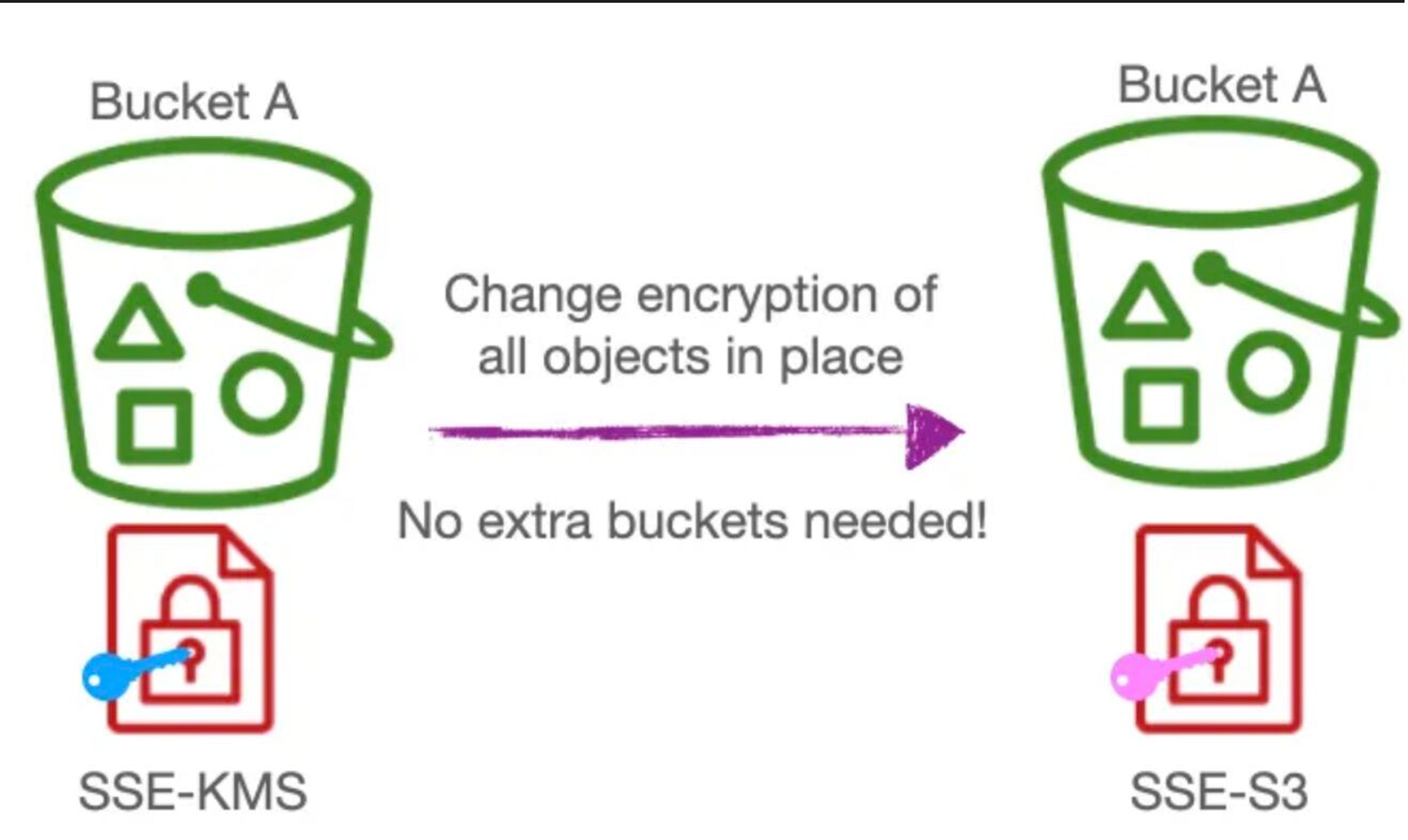
Have you ever had to migrate Amazon S3 objects from SSE-S3 to SSE-KMS or rotate encryption keys for existing S3 data? If yes, you already know how painful and risky this used to be.
The Old Reality: Encryption Changes Were Expensive and Slow
Until recently, changing server-side encryption on existing S3 objects meant one of the following:
- In-place COPY / PUT operations: Rewriting each object with new encryption headers
- Download and re-upload: Pull data out of S3 and push it back with a different encryption configuration
Both approaches came with serious drawbacks:
- Full data transfer costs, especially painful for large buckets
- Long-running jobs for millions (or billions) of objects
- Metadata inconsistencies
- Accidental ACL changes
- Lifecycle policy resets
- Object version churn
For regulated environments (banking, healthcare, government), this was often a non-starter.
The Breakthrough: UpdateObjectEncryption API
AWS has now introduced the UpdateObjectEncryption API, and it fundamentally changes how encryption migrations work in Amazon S3. You can now change the server-side encryption type of existing S3 objects:
- Without copying data
- Without downloading or re-uploading
- Regardless of object size
- Across all storage classes
This is an atomic operation that updates encryption configuration in place.
Power at Scale: S3 Batch Operations Integration
The real power emerges when you combine this API with S3 Batch Operations. Now you can:
- Apply encryption changes across entire buckets
- Process millions or billions of objects
- Track progress, retries, and failures centrally
- Automate encryption migrations as part of compliance workflows
This turns what used to be a multi-week migration into a controlled, auditable batch job.
What Is Preserved?
Unlike earlier approaches, this method preserves S3 object attributes:
- Object version IDs
- Last-modified timestamps
- ️Storage class transitions
- Lifecycle policy eligibility
- Object Lock configurations
- Access control policies (ACLs & bucket policies)
Encryption changes no longer disrupt object identity or lifecycle behavior.
Why This Matters (Especially for Enterprises)
This update is huge for organizations that need to:
- Move from SSE-S3 to SSE-KMS for compliance
- Rotate KMS keys without data movement
- Meet regulatory and audit requirements
- Reduce operational risk during security upgrades
- Avoid unnecessary data transfer costs
For security and compliance teams, this removes one of the largest blockers in enforcing encryption standards retroactively.
Have you ever delayed or avoided an S3 encryption migration because of cost, risk, or operational complexity?
If you enjoyed reading this, follow me for more cloud and AWS insights.

