A comprehensive guide to the Venafi (CyberArk product now) Certificate Management Service, its architecture on AWS, and its two integration patterns with AWS Certificate Manager.
The Problem with Certificate Management Today
Every TLS certificate in your environment is a ticking clock. It was issued with an expiry date baked in, typically one or two years from issuance and unless something deliberately renews it and pushes that renewed certificate to every service depending on it, a countdown is already underway toward an outage.
The problem is not technical complexity. Renewing a certificate is not hard. The problem is operational scale and visibility. Most organisations that run workloads across AWS, other cloud providers, and on-premises infrastructure accumulate hundreds or thousands of certificates across the systems. Some were issued by an internal certificate authority.
Some were purchased from a public CA like DigiCert or Entrust. Some were created automatically by AWS Certificate Manager. And some, inevitably, were created by a developer who needed a quick certificate for a new service and did not tell anyone.
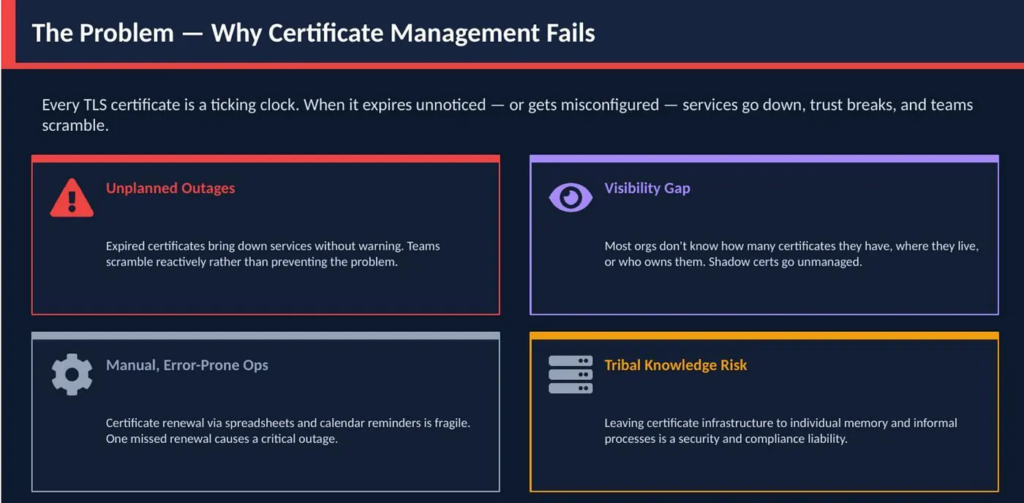
When a certificate expires unnoticed, the effects are immediate and severe. The service it protects stops responding to HTTPS requests. Load balancers begin returning errors. Applications that depend on that service start failing in cascade. Users cannot connect. Revenue stops. And somewhere in the organisation, an on-call engineer receives an alert at 2 AM and spends the next several hours tracing the root cause to a certificate that was last renewed eighteen months ago and that nobody remembered to track.
The hard truth is that most certificate management processes in the industry are still built on a fragile combination of shared spreadsheets, calendar reminders, tribal knowledge, and manual procedures. These approaches work until they do not and when they fail, they fail catastrophically and at the worst possible time.
Beyond outages, there is a deeper structural problem: the absence of governance. When certificate issuance is decentralised and informal, security teams lose the ability to enforce key length requirements, mandate approved certificate authorities, control naming conventions, or demonstrate compliance to auditors. Every certificate that exists outside a governed process is a potential liability.
1. Venafi Certificate Management Service
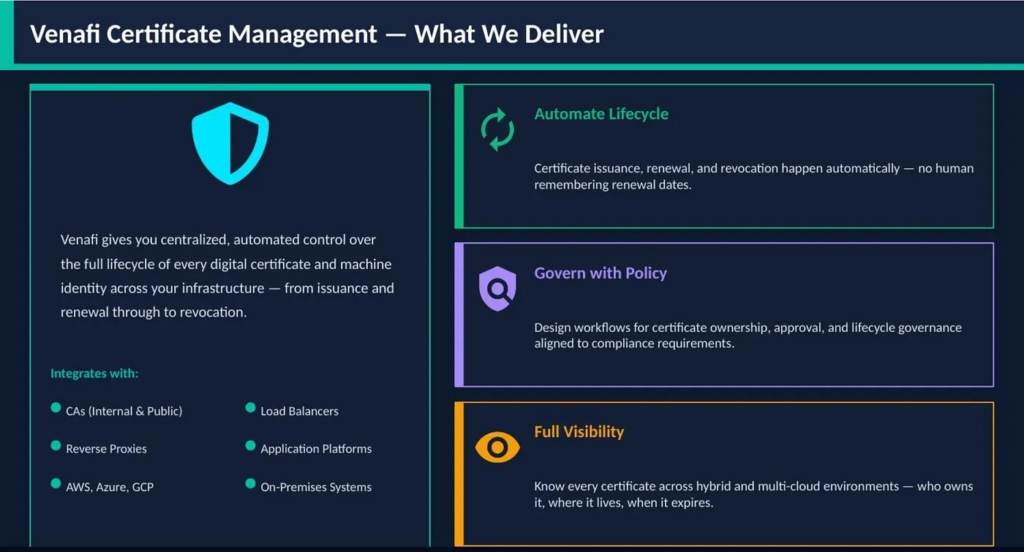
Venafi, now part of the CyberArk portfolio, is the leading platform for machine identity management. The Venafi Trust Protection Platform (TPP) provides centralised, automated control over the full lifecycle of every digital certificate and machine identity across your infrastructure , from the moment a certificate is requested through issuance, deployment, renewal, and eventual revocation.
Think of Venafi as the control plane for your certificate estate. It does not replace your certificate authorities rather it sits above them, acting as the policy enforcement layer, the orchestration engine, and the single source of truth for what certificates exist, who owns them, how they were issued, and when they expire.
1.1 What the Platform Automates
The Venafi platform automates certificate issuance, renewal, and revocation across hybrid and multi-cloud environments. To do this, it integrates with every layer of your infrastructure that touches certificates.
- On the certificate authority side, Venafi connects to your internal CA (typically Microsoft ADCS or HashiCorp Vault), public CAs like DigiCert, Entrust, GlobalSign, and Sectigo, and AWS ACM Private CA.
- On the consumption side, Venafi integrates with load balancers (F5, Citrix, NGINX), reverse proxies (HAProxy, Apache), application platforms (Kubernetes, HashiCorp Vault, ServiceNow), and cloud provider certificate stores including AWS ACM, Azure Key Vault, and GCP Certificate Manager.
The result is that a certificate lifecycle event — an issuance, a renewal, a revocation can propagate automatically from Venafi through all connected systems without any human intervention. A developer requests a certificate for a new microservice. Venafi validates the request against organization policy, routes it to the appropriate CA, receives the signed certificate, and deploys it to the Kubernetes secret store, the load balancer configuration, and the ACM store and all in a single automated workflow.
1.2 Policy and Governance
Automation without governance is just faster chaos. Venafi addresses this by making policy the foundation of every certificate operation. Every certificate request flows through a policy engine that enforces your organisation’s requirements before anything is issued. This means you can mandate minimum key lengths (no RSA-1024, only RSA-2048 or higher), restrict which certificate authorities are permitted for which use cases, enforce naming conventions and SAN (Subject Alternative Name) requirements, require approval from a named certificate owner for sensitive domains, and set maximum validity periods aligned with your compliance requirements.
“When an auditor asks who owns this certificate and when does it expire, you have an answer in seconds, not days.” The practical promise of Venafi governance.
Venafi also enables you to design multi-stage approval workflows for certificate issuance. A certificate request for a domain in your production environment might flow through automated policy validation, then require sign-off from the application team’s designated certificate owner, and then be logged to your ITSM system before issuance proceeds. This creates a complete, auditable chain of custody for every certificate in your estate.
1.3 Visibility and Discovery
One of the most powerful capabilities of the Venafi platform is discovery — the ability to actively scan your infrastructure and find certificates that were issued without going through Venafi. These “shadow certificates” are the hidden danger in most organisations’s certificate estates. They were created manually, or by a developer using the cloud console directly, or by an automated tool that bypassed the governance process. They are unknown, unmanaged, and ticking.
Venafi’s discovery engine can scan your AWS account and enumerate every certificate in ACM, every certificate in use on an ALB or CloudFront distribution, every certificate exposed on a network endpoint across your VPC. Once discovered, these certificates are imported into Venafi’s inventory, assigned to owners, evaluated against policy, and brought into the managed lifecycle. Certificate sprawl is brought under control not by preventing the past but by illuminating it and fixing it going forward.
2. Service Highlights
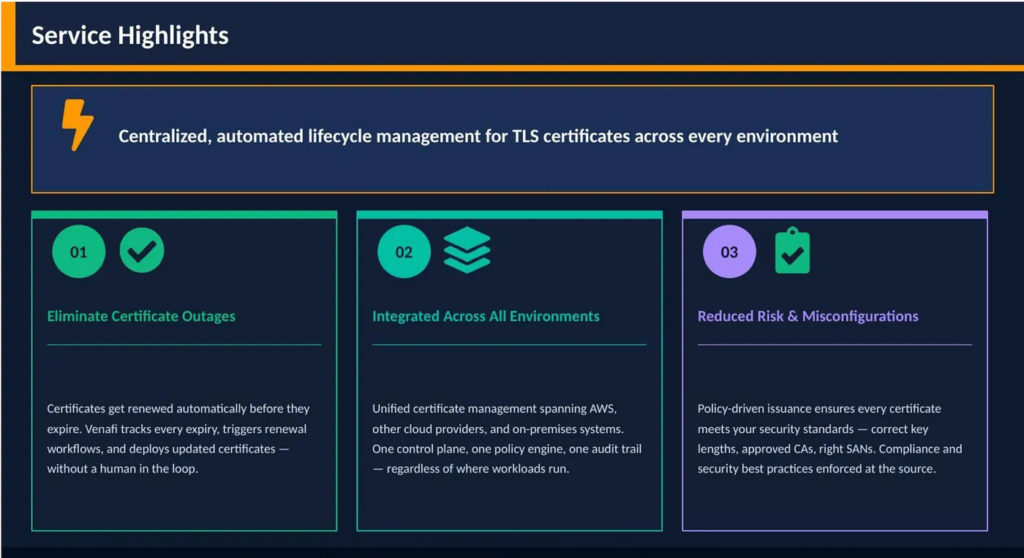
The three headline capabilities of the Venafi Certificate Management Service map directly to the three failure modes described in Section 1.
- Centralized, automated lifecycle management. Every certificate is enrolled in Venafi’s lifecycle engine from the moment it is issued. Expiry is tracked automatically. Renewal workflows trigger at configurable thresholds commonly 30 and 60 days before expiry and the renewed certificate is deployed to every connected system without human involvement. The spreadsheet is retired. The calendar reminder is gone. The 2 AM outage is prevented.
- Reduced risk of outages and misconfigurations. Because every certificate is issued through a policy engine, the class of problems caused by misconfiguration wrong key length, wrong CA, missing SAN, wrong validity period is eliminated at source. You cannot get a non-compliant certificate issued through Venafi because Venafi will reject the request before it reaches the CA.
- Integrated certificate management across AWS, cloud, and on-prem. Venafi provides a single pane of glass for your entire certificate estate regardless of where workloads run. The same policy that governs certificate issuance for your on-premises web servers applies to your AWS ALBs and your Azure Front Door endpoints. There is one control plane, one policy engine, and one audit trail.
3. AWS Deployment Architecture
The Venafi Trust Protection Platform (TPP) is deployed as a server application typically on Windows Server inside your AWS environment. A common starting architecture is a single EC2 instance running within a private subnet of your VPC, accessible only via an internal DNS name (for example, venafi.x.com resolving to the instance’s private IP through a Route 53 private hosted zone).
The EC2 instance should carries two EBS volumes:
- A primary volume for the operating system and the Venafi TPP application binaries
- and a data volume for the Microsoft SQL Server database that stores Venafi’s certificate inventory, policy configuration, workflow state, and audit logs. The SQL Server database is the heart of the deployment — it contains the full history of every certificate that Venafi has ever managed.
Important architectural note: A single-node Venafi deployment is a single point of failure. For production environments, Venafi recommends a distributed, high-availability deployment with a dedicated SQL Server (ideally on RDS or an Always On Availability Group), multiple TPP nodes behind an internal load balancer, and a documented disaster recovery plan.
The EC2 instance should have an IAM instance profile attached. An IAM role that grants the instance the permissions it needs to interact with AWS services. This is the secure, AWS-recommended way to give EC2 applications access to AWS APIs without storing static credentials anywhere on the instance. The IAM role is the mechanism through which Venafi communicates with AWS Certificate Manager
3.1. Integrating Venafi with AWS Certificate Manager
AWS Certificate Manager (ACM) and Venafi serve complementary roles. ACM is excellent at what it does: it provisions and auto-renews TLS certificates for AWS-native services — Application Load Balancers, CloudFront distributions, API Gateway endpoints, and other services that integrate with ACM natively. ACM is simple, free for public certificates, and deeply integrated into the AWS service fabric.
But ACM has a significant limitation:
- it is a closed system.
- Certificates issued by ACM cannot be exported or used outside AWS.
- It has no concept of policy enforcement — any IAM principal with the right permissions can request a certificate for any domain.
- It has no approval workflow
- no ownership model, and
- no inventory that spans beyond a single AWS account.
For organisations with security governance requirements, compliance obligations, or hybrid infrastructure, ACM alone is insufficient.
Venafi fills exactly these gaps. The integration between Venafi and ACM creates a unified system where Venafi provides the governance, policy enforcement, and cross-environment visibility, while ACM continues to serve as the efficient, AWS-native delivery mechanism for certificates used by AWS services.
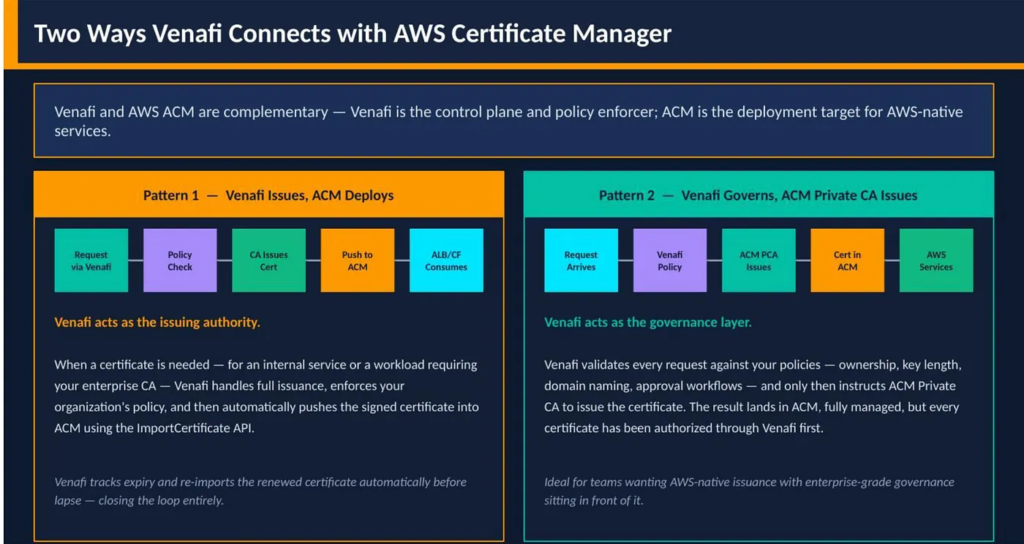
There are two distinct integration patterns, each suited to different architectural needs. Understanding the difference between them is the key to choosing the right approach for your environment.
3.2 Pattern 1 — Venafi Issues the Certificate, ACM Deploys It
In this pattern, Venafi acts as the full issuing authority. The certificate is created by Venafi and Venafi then pushes the resulting certificate into ACM using the ImportCertificate API. From that point onward, ACM serves the certificate to AWS resources just as it would any natively issued certificate.
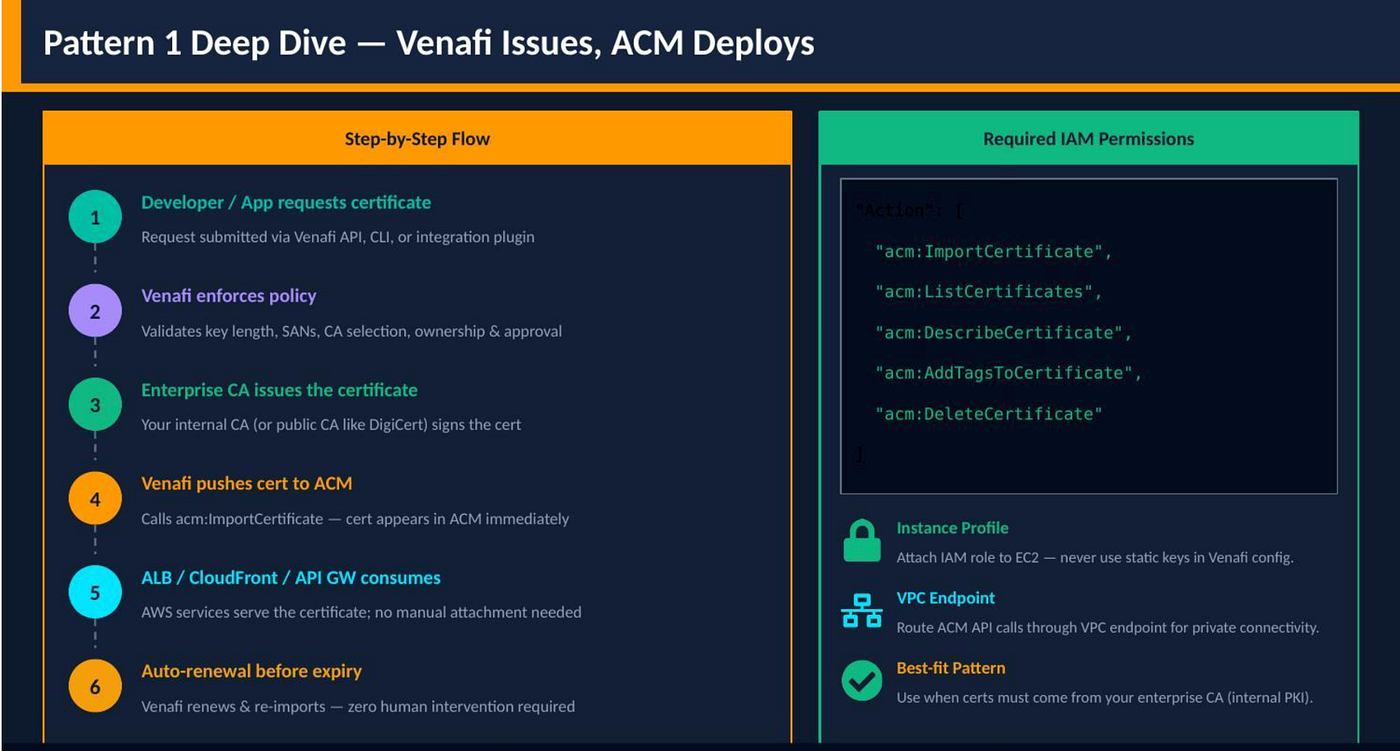
Here is how the end-to-end flow works:
- A developer, an application pipeline, or an automated integration submits a certificate request to Venafi either through the Venafi web console, the REST API, or a plugin for a tool like Kubernetes cert-manager or HashiCorp Vault.
- Venafi’s policy engine evaluates the request: is the key length acceptable? Is the requested CA approved for this domain? Does the requestor have the authority to request a certificate for this SAN? Does the request need a human approval step?
- If the request passes policy validation, Venafi routes it to the configured certificate authority.
- The CA signs the certificate and returns it to Venafi.
- Venafi then calls the AWS ACM ImportCertificate API, submitting the certificate body, the private key, and the full certificate chain.
- The certificate appears in ACM and can be attached to any compatible AWS resource.
The Venafi ACM driver also handles the renewal cycle:
- Before the certificate expires, Venafi automatically initiates a renewal
- Obtains a new certificate from the CA, and
- Calls ImportCertificate again to replace the old certificate in ACM
Because ACM supports in-place certificate replacement — the ARN of the certificate stays the same after an import update — the ALB or CloudFront distribution attached to that certificate automatically begins serving the new certificate without any configuration changes.
This pattern is ideal when your organisation must use its own PKI (internal CA infrastructure) as the issuing authority, while still wanting the convenience of ACM as the delivery and attachment mechanism for AWS services.
The IAM permissions required for this pattern are straightforward. The EC2 instance running Venafi needs an IAM role with the following ACM actions:
{
  #to push new and renewed certificates;
  acm:ImportCertificate,
  #to discover what already exists in ACM;
  acm:ListCertificates,
  #to check certificate status and metadata;
  acm:DescribeCertificate
  #to tag certificates for tracking and cost allocation;
  acm:AddTagsToCertificate
  #and optionally
  acm:DeleteCertificate to clean up expired or superseded certificates.
}
These permissions should be attached to the EC2 instance profile, never embedded as static access keys in the Venafi configuration.
3.3 Pattern 2 — Venafi Governs, ACM Private CA Issues
In this pattern, the roles shift. Venafi is no longer the issuing system instead, it acts as the governance and policy gate. The actual certificate issuance is handled by AWS ACM Private CA, which is Amazon’s managed private certificate authority service. Venafi stands between the requestor and ACM Private CA, ensuring that no certificate can be issued without first passing through Venafi’s policy engine and approval workflow.
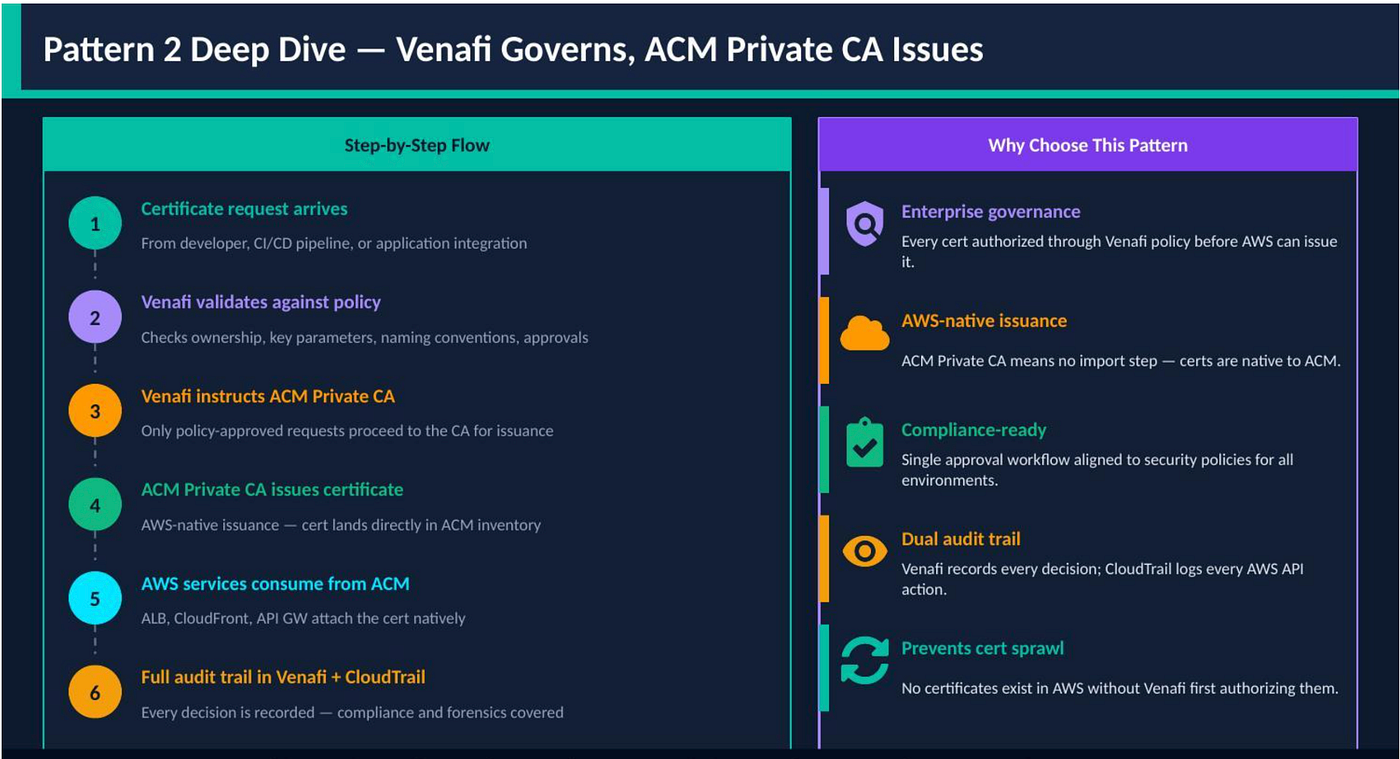
The flow works as follows:
- A certificate request arrives in Venafi again, through any of Venafi’s intake channels.
- Venafi validates the request against policy, running the same checks as Pattern 1: key length, CA eligibility, naming conventions, ownership, and approval requirements.
- If the request is approved, instead of routing to an internal CA or public CA, Venafi calls ACM Private CA’s API to issue the certificate.
- ACM Private CA signs the certificate and delivers it directly into the ACM certificate store, where it is immediately available for use by AWS services.
The key difference from Pattern 1 is that the certificate is native to ACM — it was issued by an ACM CA and lives in ACM from the moment of issuance. There is no import step, no private key material handled outside AWS, and the certificate benefits from ACM’s native managed renewal capabilities.
What Venafi adds to this flow is the layer that ACM Private CA lacks on its own: governance. Without Venafi, any IAM principal with appropriate permissions could call ACM Private CA to issue any certificate with any attributes. With Venafi in front of ACM Private CA, every issuance must pass through the policy engine, every approval workflow is enforced, and every certificate that exists in your AWS environment has been authorised by your central certificate governance system.
This pattern is especially powerful for teams that want AWS-native issuance benefiting from ACM’s managed renewal and deep AWS integration but need enterprise-grade governance and audit capability sitting in front of every issuance decision.
An additional advantage of this pattern is the dual audit trail:
- Venafi logs every policy evaluation, every approval decision, and every issuance instruction.
- CloudTrail logs every ACM Private CA API call that results from Venafi’s instruction.
Together, these two audit trails provide a forensically complete record of every certificate lifecycle event — who requested it, what policy it was evaluated against, who approved it, and exactly when AWS issued it.
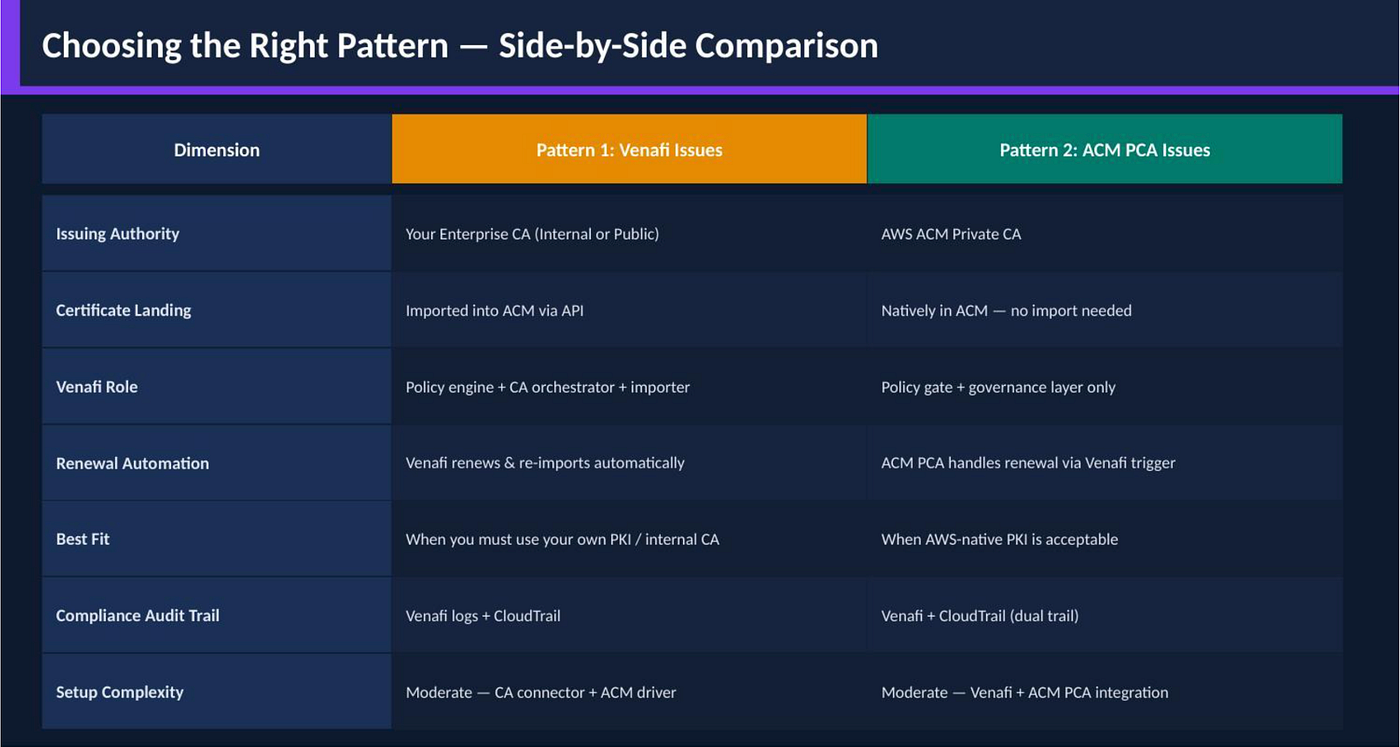
3.4 Choosing Between the Two Patterns
The two patterns are not mutually exclusive. Many organisations deploy both simultaneously — Pattern 1 for workloads that require certificates from their existing internal PKI, and Pattern 2 for greenfield AWS-native workloads where ACM Private CA is acceptable as the issuing authority. Venafi provides a unified view and governance layer across both, so the policy experience is consistent regardless of which CA ultimately signs the certificate.
The table below summarises the key differences across the seven dimensions that matter most when choosing between the patterns.
4. Security Best Practices for the Integration
Deploying Venafi on AWS and connecting it to ACM introduces a set of security considerations that should be addressed in the initial architecture and revisited regularly.
- Use IAM instance profiles, never static keys. The Venafi EC2 instance needs AWS credentials to call ACM APIs. The correct way to provide those credentials is through an IAM instance profile . An IAM role attached to the EC2 instance. When the Venafi application calls an AWS API, it automatically retrieves short-lived, automatically rotating credentials from the instance metadata service. Never configure static access keys in the Venafi application settings. Static keys are a significant security risk they do not rotate automatically, they are often inadvertently committed to source control, and if compromised they remain valid until manually revoked.
- Apply least-privilege IAM policies. Grant Venafi only the ACM permissions it needs, and consider scoping the Resource element of the policy to specific ACM certificate ARNs or AWS regions rather than the wildcard asterisk. In production environments, restricting permissions to the specific regions where Venafi manages certificates significantly reduces the blast radius of a credential compromise.
- Use VPC endpoints for ACM. By default, calls from your Venafi EC2 instance to the ACM API traverse the public internet (via the AWS global network). Creating an interface VPC endpoint for ACM keeps API traffic entirely within the AWS network fabric, never leaving the private address space. This reduces exposure and eliminates the need to configure outbound internet access for the Venafi instance just for ACM API calls.
- Enable CloudTrail and set up alerting. Every ACM API call made by Venafi will appear in CloudTrail. Configure CloudTrail alerts for unusual patterns — for example, acm:ImportCertificate calls from principals other than the Venafi instance profile, or an unexpected volume of certificate import operations. This provides early warning of misuse or compromise.
- Harden the Venafi EC2 instance. The Venafi instance holds a privileged position in your certificate infrastructure. Treat it accordingly. Restrict SSH or RDP access using security groups and AWS Systems Manager Session Manager rather than open ingress rules. Apply AWS-managed patches automatically. Enable Amazon Inspector for vulnerability assessment. Configure backups of the EBS data volume (the SQL Server database) using AWS Backup with an appropriate retention period.
5. Who This Service Is For
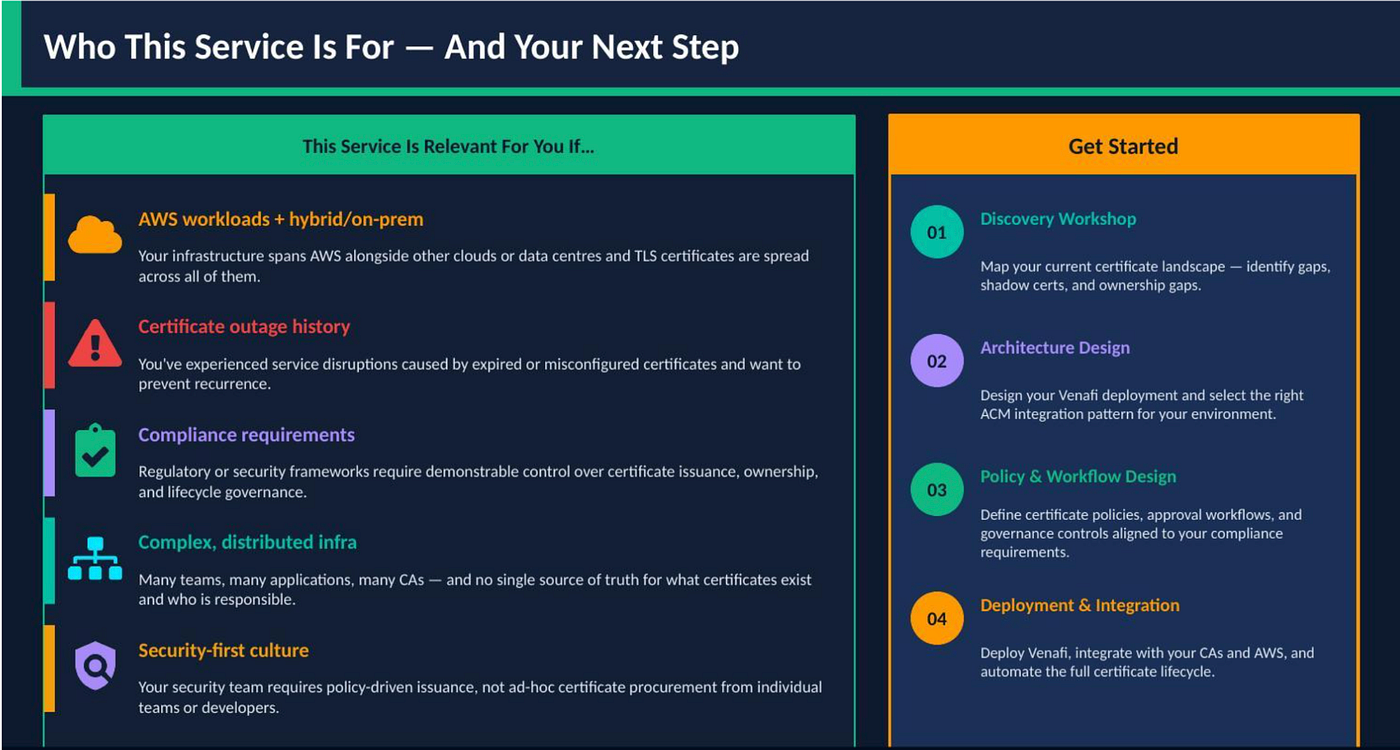
The Venafi Certificate Management Service is most relevant for organisations that share one or more of the following characteristics.
- You run workloads on AWS alongside other cloud providers or on-premises infrastructure, and your TLS certificates are spread across all of these environments. You have no single system that shows you all certificates in one place.
- You have experienced service disruptions caused by expired or misconfigured certificates and you want a structural solution not a reminder email that prevents recurrence.
- Your organisation is subject to regulatory or security frameworks (PCI DSS, SOC 2, HIPAA, ISO 27001, or internal security policies) that require demonstrable, auditable control over certificate issuance, ownership, and lifecycle. Your current process cannot produce this evidence reliably.
- You operate complex, distributed infrastructure with many application teams, many CAs, and no single source of truth for what certificates exist, who is responsible for them, and what their status is.
- Your security team wants policy-driven certificate issuance not ad hoc procurement from individual developers using the AWS console and needs a technical mechanism to enforce that policy.