
Goal: Understand what MLOps is, why it exists, and how it differs from DevOps.
Estimated Time: 60–90 minutes
By the end of this lesson, you should be able to:
MLOps (Machine Learning Operations) is the discipline of applying engineering, DevOps, and data engineering practices to build, deploy, monitor, and maintain machine learning systems in production.
Think of it as:
DevOps + Data Engineering + Machine Learning Engineering + Monitoring + Governance
Traditional DevOps answers:
“How do we reliably deploy software?”
MLOps answers:
“How do we reliably deploy software and continuously improve machine learning models using changing data?”
Input
↓
Application
↓
Output
Machine learning system behave differently
Training Data
      ↓
Feature Engineering
      ↓
Model Training
      ↓
Model
      ↓
Predictions
      ↓
Feedback
      ↓
Retraining
Unlike software:
This introduces new operational challenges.
| Traditional Software | Machine Learning |
|---|---|
| Code determines behavior | Data determines behavior |
| Logic written by developers | Logic learned from data |
| Rarely retrained | Frequently retrained |
| Version code | Version code + data + models |
| CI/CD | CI/CD + CT (Continuous Training) |
Consider a machine learning model designed to classify incoming emails as spam or legitimate.
The model was trained using email data collected in Y2025, allowing it to learn the spam patterns, message structures, keywords, sender characteristics, and behavioral signals present at that time.
Training environment
2025 Email Data → Model Training → 98% AccuracyWhen the model is deployed to production in 2026, the underlying application and infrastructure continue to operate normally. Requests are processed successfully, the inference API remains available, and predictions are returned without errors.
However, spam behavior has evolved.
Spammers may introduce new techniques such as:
As a result, the characteristics of production data begin to differ from the data the model originally learned from.
Production environment
2026 Email Data → Changed Spam Patterns → Model Accuracy Drops from 98% to 79%This illustrates an important difference between traditional software systems and machine learning systems:
A machine learning application can be operationally healthy while its model is producing increasingly inaccurate predictions.
This degradation in model effectiveness over time is commonly associated with model drift. The statistical properties of the data, the relationship between input features and outcomes, or real-world behavior may change after deployment, causing the model’s production performance to deteriorate.
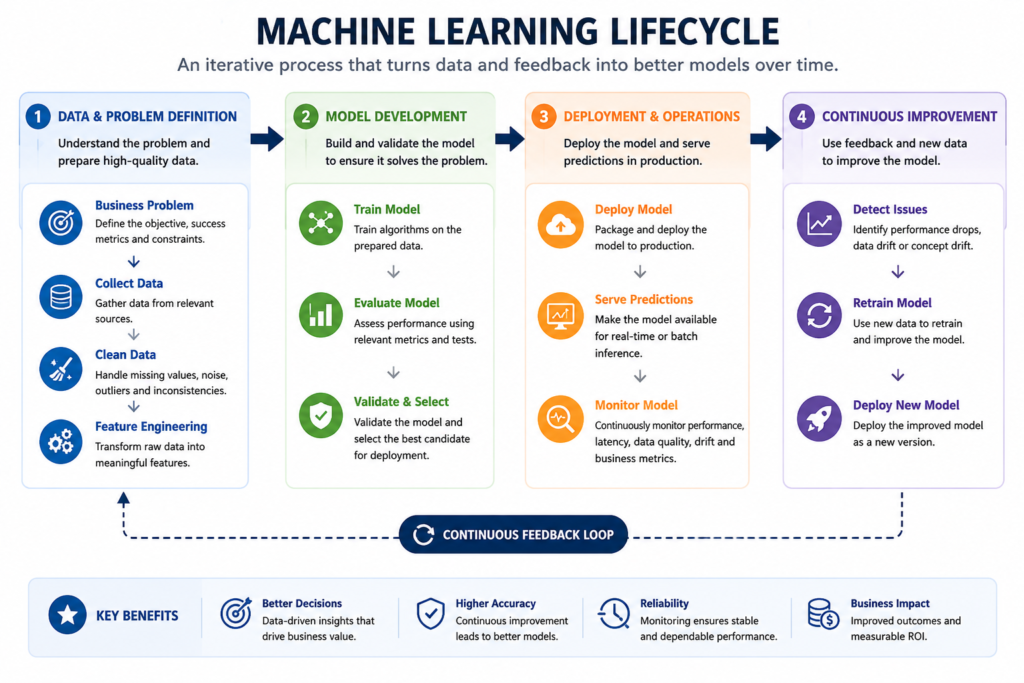
The machine learning lifecycle is an iterative process that transforms business requirements and data into production models, with continuous monitoring and feedback driving retraining and improvement continuously.
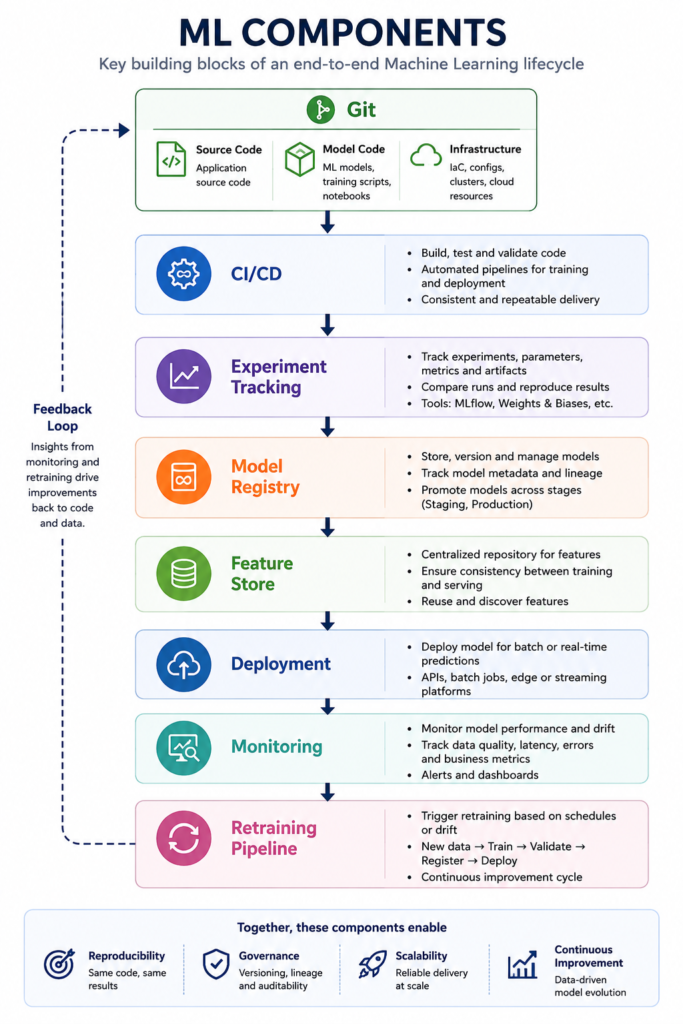
A production ML platform typically includes:
| Data Scientist | ML Engineer | Data Engineer |
| – Explore data – Build models – Tune algorithms | – Productionize models – Build training pipelines – Deploy inference services | – Build ETL pipelines – Manage data quality – Prepare datasets |
| Platform Engineer / DevOps | SRE | |
| – Kubernetes – CI/CD – Infrastructure – Security – Observability | – Reliability – Availability – Monitoring – Incident response – Capacity planning |
Suppose you’re building a house-price prediction system. Here every arrow can be automated.
Raw CSV
      ↓
Validation
      ↓
Cleaning
      ↓
Feature Engineering
      ↓
Training
      ↓
Evaluation
      ↓
Model Registry
      ↓
Docker Image
      ↓
Kubernetes
      ↓
Prediction API
      ↓
Monitoring
      ↓
Retraining
Real-World Example
Consider a recommendation engine for an e-commerce platform.
Daily process:
This continuous cycle is the essence of MLOps.
For the MLOps tutorial, I would present the stack by capability, because enterprises rarely use one platform for everything. They typically combine cloud-native services, commercial platforms, and open-source components
| MLOps Layer | Popular Tools / Platforms | License / Offering | Typical Enterprise Use |
|---|---|---|---|
| Source Control | GitHub, GitLab, Bitbucket | Free + Paid | Version control for ML code, pipelines, configuration and IaC |
| CI/CD | Jenkins, GitHub Actions, GitLab CI/CD, Argo CD | Open Source / Paid | Build, test, validate and deploy ML applications |
| Workflow Orchestration | Apache Airflow, Kubeflow, Prefect | Open Source + Commercial options | Orchestrate data preparation, training and retraining workflows |
| Experiment Tracking | MLflow, Weights & Biases, Neptune | Open Source / Commercial | Track parameters, metrics, artifacts and experiment history |
| Model Registry | MLflow Model Registry, Amazon SageMaker, Azure Machine Learning, Vertex AI | Open Source / Paid | Model versioning, lineage, approval and lifecycle management |
| Feature Store | Feast, Tecton, Databricks Feature Store | Open Source / Paid | Centralized feature management and online/offline feature serving |
| Data & Model Versioning | DVC, Git LFS, MLflow | Open Source + Paid | Version datasets, artifacts and model files |
| Distributed Training | Ray, Kubeflow Training, SageMaker Training | Open Source / Paid | Large-scale and distributed ML workloads |
| Model Serving | KServe, BentoML, SageMaker Endpoints, Vertex AI | Open Source / Paid | Real-time and batch model inference |
| Containerization | Docker, Kubernetes | Open Source + Paid offerings | Package and run reproducible ML workloads |
| Infrastructure as Code | Terraform, OpenTofu, AWS CloudFormation | Open Source / Source-available / Paid | Provision reproducible ML infrastructure |
| Model Monitoring | Evidently, Arize AI, Fiddler AI | Open Source / Paid | Detect drift, performance degradation and data-quality issues |
| Infrastructure Monitoring | Prometheus, Grafana, Datadog | Open Source / Paid | Monitor infrastructure, APIs, latency and resource utilization |
| End-to-End ML Platform | Databricks, Amazon SageMaker, Azure ML, Vertex AI | Commercial / Managed | Integrated enterprise ML development and operations |
| ML Platform on Kubernetes | Kubeflow | Open Source | Build portable, Kubernetes-native ML platforms |
Managing the full lifecycle of machine learning systems, including data, models, deployment, monitoring, and retraining.
Because changes in data can change model behavior; reproducibility requires versioning datasets alongside code.
A decline in model performance caused by changes in data or its relationship to the target over time.
Deployment
Because production data evolves and model performance can degrade.