
Idempotency means running the same operation multiple times produces the exact same result as running it once.
In data engineering, an idempotent pipeline can be safely re-run after a failure, a retry, or a manual restart and all without creating duplicate data or corrupting what’s already there.
All these aren’t a hypothetical edge case rather it’s a certainty over a long enough timeline, and it happens constantly at scale.
The question isn’t whether a pipeline will need to be re-run rather it’s what happens when it is. If a pipeline isn’t idempotent, re-running it after a partial failure can silently double-count revenue, duplicate customer orders in a report, or corrupt a machine learning model’s training data which often without throwing any error at all. This is one of the most common causes of “the numbers don’t match” incidents that take days to trace back to their root cause.
If you’re technical lead or an architect, this is worth making a non-negotiable standard rather than a nice-to-have: every production pipeline should be safe to re-run. It’s far cheaper to design for this upfront than to debug silent data corruption in production months later.
Imagine a pipeline that processes new orders and increments a total_revenue counter for each one.
Not idempotent:
UPDATE daily_summary
SET total_revenue = total_revenue + 500
WHERE order_date = '2026-09-13';
If this job fails halfway through and gets re-run, or accidentally runs twice, total_revenue gets incremented twice and the number is now wrong, and nothing in the system flags it.
Idempotent version:
INSERT INTO daily_summary (order_date, total_revenue)
VALUES ('2026-09-13', 500)
ON CONFLICT (order_date)
DO UPDATE SET total_revenue = EXCLUDED.total_revenue;
Or, even more robustly, recompute the total from source records rather than incrementing:
INSERT INTO daily_summary (order_date, total_revenue)
SELECT order_date, SUM(amount)
FROM orders
WHERE order_date = '2026-09-13'
GROUP BY order_date
ON CONFLICT (order_date)
DO UPDATE SET total_revenue = EXCLUDED.total_revenue;
Here, order_date must be a primary key or have a unique constraint in the daily_summary table.
Run this once, run it five times, run it after a crash halfway through and the result is identical every time, because it always recomputes the true total rather than blindly adding to whatever was there before.
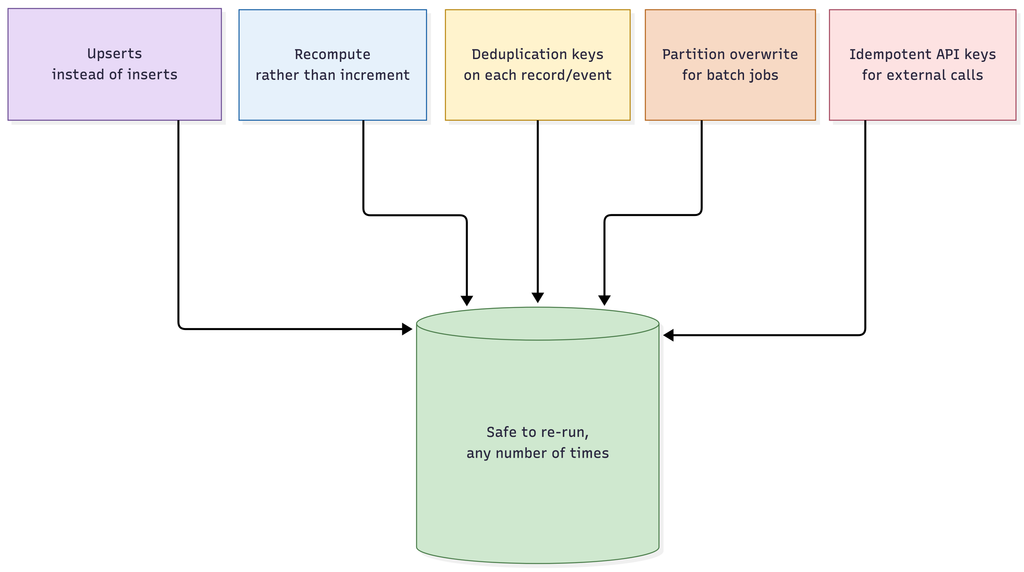
Idempotency is more of a design principle than a specific tool, but these help enforce it in practice:
| Company / Scenario | What could go wrong without idempotency | How idempotency prevents it |
|---|---|---|
| Swiggy/Zomato — order placement events reaching the billing system twice (a common network-retry scenario) | A customer gets billed twice for the same order if the “charge customer” event is processed more than once. | The billing service checks the order’s unique ID before processing and if that ID has already been charged, the duplicate event is safely ignored. |
| Amazon — a nightly inventory reconciliation job crashes halfway through and gets re-run | Stock counts get adjusted twice for the records processed before the crash, showing incorrect inventory levels. | The job overwrites the full inventory snapshot for that day rather than incrementally adjusting counts, so re-running it from scratch produces the same correct result. |
| A bank — a payment retry after a network timeout | The bank’s system might not know if the original payment actually went through before the timeout and blindly retrying could double-charge the customer. | Payment APIs support idempotency keys and the same key sent twice is recognized as the same request, and only processed once. |
| Uber/Ola — a driver-payout batch job is manually restarted after being accidentally triggered twice | Drivers could be paid twice for the same set of trips. | The payout job recomputes total earnings from trip records for the pay period rather than adding to a running balance, so restarting it produces the identical, correct payout amount. |