
Machine learning development becomes difficult to manage as soon as experimentation moves beyond a single model and a single developer. During model development, teams typically run many experiments with different datasets, features, algorithms, hyperparameters, and training configurations. Each experiment produces information that matters later: which parameters were used, what metrics were achieved, which artifacts were generated, and which version of the model eventually became useful.
Without a systematic way to capture this information, machine learning development can quickly become difficult to reproduce and maintain. A developer may remember that one experiment produced the best accuracy but no longer know exactly which parameters or dataset produced it. Models may be stored as files with unclear versioning, and moving a model from experimentation into a production environment can require additional manual work.
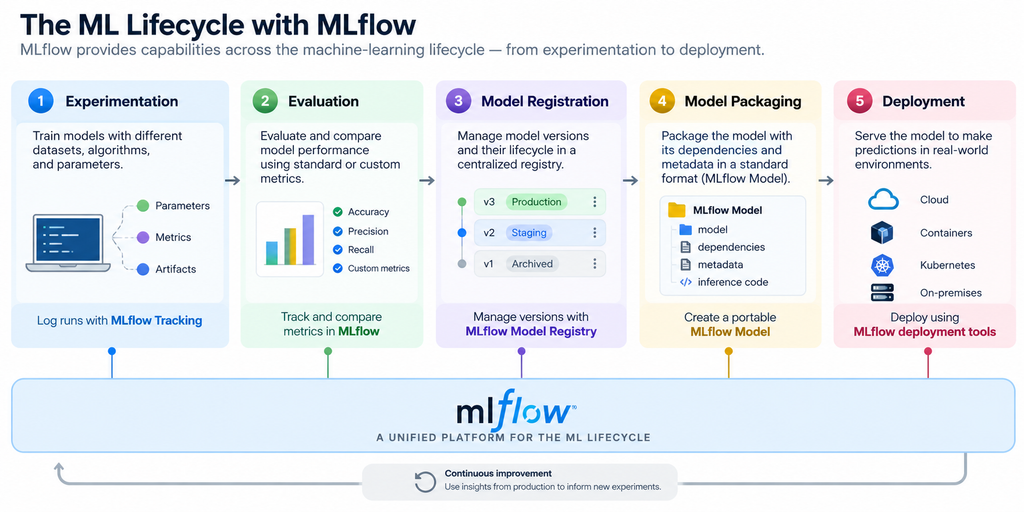
MLflow addresses this broader machine-learning lifecycle problem. It is an open-source platform for managing machine-learning and AI workflows, with capabilities covering areas such as experiment tracking, model packaging, model evaluation, model registry, deployment, and observability for modern AI applications.
The important thing to understand is that MLflow is not a machine-learning algorithm or framework. It does not replace scikit-learn, PyTorch, TensorFlow, XGBoost, or similar tools. Instead, it provides infrastructure around these tools so that the work performed with them can be tracked, organized, evaluated, reproduced, and moved toward production.
Consider a data scientist developing a customer-churn model. They might start with logistic regression, then try a random forest, and later experiment with XGBoost. For each model, they may change parameters such as learning rate, tree depth, number of estimators, feature-selection strategies, or training data.
The actual development process therefore looks more like this:
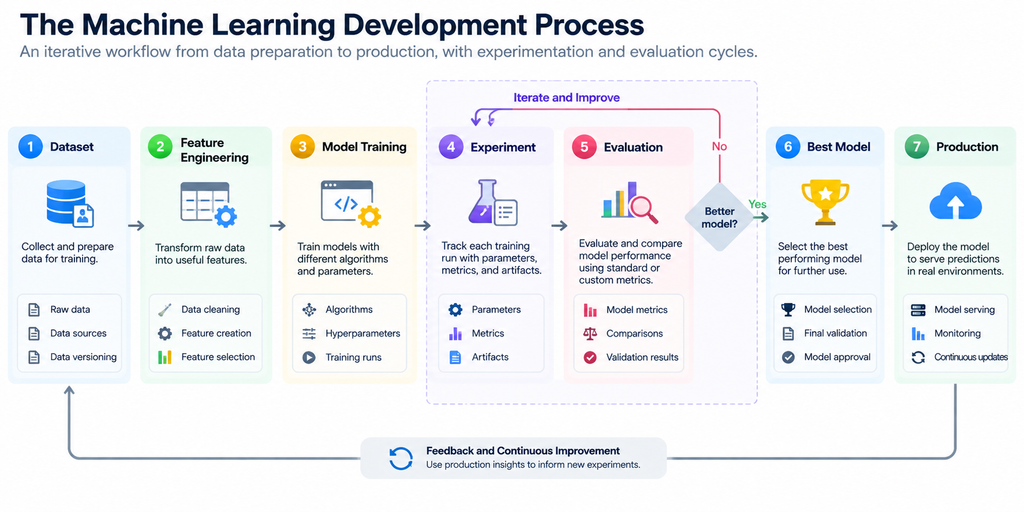
The difficulty is not training any individual model. The difficulty is managing everything that happens across these iterations.
MLflow Tracking provides a mechanism for recording runs and their associated parameters, metrics, artifacts, and metadata. This allows experiments to be compared systematically instead of relying on manually maintained notes, filenames, or directory structures.
This becomes increasingly important when multiple people are working on the same project. An ML system needs to answer questions such as:
Which experiment produced this model?
Which parameters were used?
What metrics did it achieve?
Which model version is currently being used?
Can we reproduce the result?
These are fundamentally MLOps problems, rather than machine-learning algorithm problems.
MLflow provides several capabilities that address different parts of this lifecycle.
To make the MLflow tutorial easier to follow, we will use a consistent set of roles representing the key responsibilities involved in taking a machine-learning model from experimentation to production.
Focus: Model development and experimentation.
Priya prepares data, engineers features, trains models, tunes hyperparameters, runs experiments, and evaluates model performance.
Key concepts: Experiments, runs, parameters, metrics, artifacts, and evaluation.
Focus: Model engineering and deployment.
Arjun takes validated models and makes them production-ready by handling packaging, dependencies, inference, serving, testing, and deployment.
Key concepts: MLflow Models, model versions, serving, packaging, and deployment.
Focus: ML infrastructure and operations.
Maya provides and operates the infrastructure required for teams to use MLflow reliably, including tracking infrastructure, storage, access, and scalable deployment environments.
Key concepts: MLflow architecture, tracking servers, backend stores, artifact stores, access, and operations.
Focus: Connecting the workflow.
MLflow provides the platform capabilities that support the team across experimentation, evaluation, model management, packaging, deployment, and AI/ML operations.
Key concepts: Tracking, evaluation, Model Registry, MLflow Models, deployment, and observability.
Focus: Reliability and operational requirements.
Production represents the environment where models must operate reliably. It introduces practical requirements such as reproducibility, version control, deployment reliability, rollback, and operational management.
Key concepts: Production readiness, reliability, reproducibility, versioning, and lifecycle management.
The responsibilities follow the natural ML lifecycle:
Data Scientist → ML Engineer → Platform Engineer → Production
MLflow provides capabilities across this lifecycle, connecting experimentation and model development with the engineering and infrastructure required to operate ML systems in production.